Posts

2034: Various Meanings of 'Cob' Jul 10, 2020

'Cob' in Old English meant 'spider' , hence ' cobwebs ', but that is not the same one as in 'corn-on-the-cob'. Indeed, the word has many unrelated meanings, including 'a mound of clay or coal', 'a head', 'a male swan', and 'a short-legged horse' and a 'bread roll'. Some others have been argued to be from different though unknown etymologies, but the oldest sense of 'cob' meant 'strong man; leader'. From this it is believed that the rest came about, basically in the sense that each are sturdy or at least round. That said, with these old monosyllabic words, it is often difficult to discern if the common thread is coincidental or not. Watch the latest video . Get Word Facts Merch . Support on Patreon.com/wordfacts
2033: Beavers in the River Otter Jul 9, 2020

There is only one river in England where beavers live, and that is in the River Otter. Indeed, while there are many names for rivers in Britain derived from Celtic , far more than would be expected for any other name for natural features or settlements, this river was actually named for the otters who inhabit it, and it is only by a modern coincidence that it is arguably now more famous for the beaver population. Watch the latest video . Get Word Facts Merch . Support on Patreon.com/wordfacts

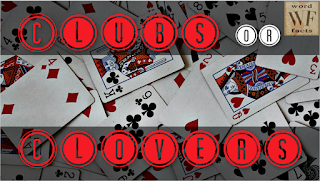
2032: Clubs or Clovers(Suit of Cards) Jul 8, 2020

Image
Of the 4 suits in a French card deck,  ♣ ♦ ♠ ♥ , the name which makes the least sense is probably the clubs ( ♣ ). In French these are 'trèfle' (clover), which helps to explain the shape of the card, but the name comes from the name in the Spanish deck 'baston' which means 'baton' or in other words, 'club'. The French name is retained in some other languages though, as with the Austrian German 'Treff' which would otherwise mean 'meeting' in German. Watch the latest video . Get Word Facts Merch . Support on Patreon.com/wordfacts

2031: Hobo Signs (Systemized Graffiti) Jul 7, 2020

Some hobo-slang has entered into mainstream American English over the years, but perhaps more famous are the hobo-signs: systematized cryptic graffiti as a way to communicate with other hobos. These would be left around relevant places like railroads, personal homes, water-towers and doctors' offices to indicate things like "fresh water; safe place to sleep" (a squiggle with OXO underneath), "doctor won't charge" (plus sign with a circle in the top-right corner), or 'mean dog here'—or as they might have said, 'bone polisher'—(a box with 4 vertical lines connected by a horizontal line within). Many of these the subject of urban legends as well, but they had been in use since at least the 1870's. Watch the latest video . Get Word Facts Merch . Support on Patreon.com/wordfacts

2030: Hobo Slang in Mainstream Use Jul 6, 2020

While the hobo-lifestyle diminished in the latter half of the 20th century, there are two significant linguistic developments they introduced, including slang, as well as hobo-signs, which will be discussed in the next post. Indeed, while much of the slang has faded into obscurity like 'Bone orchard' (cemetery), 'California blankets' (newspapers) or 'Blowed-in-the-glass' (a trustworthy person), many entered mainstream lexicon. Some of these, like 'bighouse' (prison), 'flop [house]' (a cheap hotel), and 'main drag' (busy road) to name a few are still frequently used in American English outside of the hobo-community. Check out the new video Get Merch: teespring.com/stores/word-facts Support on Patreon.com/wordfacts

2029: sacrum Jul 5, 2020

We probably don't think of biology as being terribly spiritual, but there are a few lingering terms that are. For instance, the 'sacrum' has for a long time been understood to be where the soul resides. For reference, the sacrum is the bone at the base of the spine between the hip-bones. Many cultures including the Egyptians, Greeks, and Israelites understood this to be so, and hence the name '(os) sacrum' comes from the Latin meaning 'sacred (bone)'. Check out the new video . Get Merch . Support on Patreon.com/wordfacts

2028: gazump Jul 4, 2020

A number of words entered English from Yiddish, but due to the relative number of native speakers—at times nearly 100 times as many in the US as opposed to the UK—most of these were adopted into American English first. That wasn't always true though, as with the word 'gazump' which is part of British slang meaning 'swindle' or 'increase the price (of a house) from an original agreement' from the Yiddish meaning 'to overcharge'. Check out the new video . Get Merch . Support on Patreon.com/wordfacts

2027: Holy Ghost, or Holy Breath Jul 3, 2020

The word 'ghost' today mostly denotes a supernatural entity, but in its oldest forms it just related to breath; in Old English 'gast' meant 'breath'. Indeed, the Latinate form of that, 'spirit', comes from 'spiritus' which also meant 'breath'. This is why the Hebrew רוח הקודש (ruach hakodesh) and later the Greek πνεῦμα (pneuma, related to 'pneumonia') most literally translates as as 'holy breath', but is usually translated as 'holy spirit' or 'holy ghost'. Moreover, while the  connotations to supernatural beings is an old association it is not the only one, since even in English 'spirit' can just relate to vigor, and in German 'Geist' means 'mind' as well as the supernatural 'spirit'. Check out the new video . Get Merch . Support on Patreon.com/wordfacts